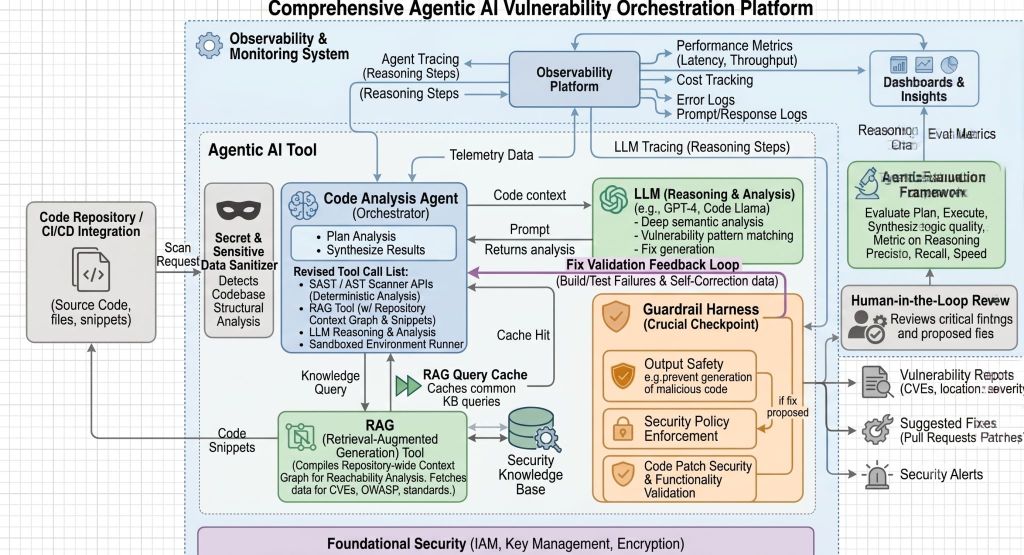
One of the problems I keep coming back to is: how do you catch security vulnerabilities before they escape into production, without turning every pull request into a bottleneck for human reviewers? Static analyzers catch a slice of the problem, but they lack context — they don’t understand what the code is actually trying to do, how a vulnerability might be reachable in practice, or how to propose a fix that doesn’t also break the build.
That’s the gap an agentic AI architecture is well suited to close. Below is a walkthrough of a platform design I’ve been refining for exactly this: an orchestrated pipeline that reasons about code the way a senior security engineer would, but runs on every check-in.
The entry point: sanitize before you reason
Code enters the pipeline from a repository or CI/CD scan request. Before anything touches a model, it passes through a Secret & Sensitive Data Sanitizer that detects and strips things like credentials or tokens from the codebase. This matters more than it sounds — you don’t want secrets from a scanned repo ending up in a prompt, a log, or a cached embedding.
The orchestrator: a Code Analysis Agent, not a single model call
At the center is a Code Analysis Agent that acts as an orchestrator rather than a single LLM call. It plans the analysis, decides which tools to invoke, and synthesizes the results. Its tool call list is deliberately mixed:
- SAST / AST scanner APIs for deterministic analysis — the things you don’t want an LLM guessing at.
- A RAG tool that pulls in a repository-wide context graph, so the agent understands how code is actually connected, not just the diff in front of it.
- LLM reasoning for the semantic layer — the part that needs judgment, not just pattern matching.
- A sandboxed environment runner to actually execute and validate candidate fixes.
This mix is intentional: deterministic tools for what’s deterministic, an LLM for what requires understanding intent.
RAG: reachability, not just retrieval
The RAG (Retrieval-Augmented Generation) Tool compiles a repository-wide context graph for reachability analysis — is this vulnerable function actually callable from an external input, or is it dead code? It fetches from a Security Knowledge Base covering CVEs, OWASP categories, and internal standards, with a query cache in front of it so common knowledge-base lookups don’t get re-fetched on every run.
The LLM’s job: analysis and fix generation, nothing more
The LLM layer (GPT-4, Code Llama, or similar) receives code context and a prompt from the orchestrator, and returns deep semantic analysis, vulnerability pattern matching, and fix generation. It does not get to ship anything on its own — everything it proposes has to clear the next stage.
The Guardrail Harness: the crucial checkpoint
This is the part I’d call non-negotiable in any agentic system that touches production code. Before a proposed fix goes anywhere, it passes through a Guardrail Harness with three checks:
- Output safety — preventing the generation of malicious code, intentional or accidental.
- Security policy enforcement — does the fix actually comply with the org’s security standards?
- Code patch security & functionality validation — does the patch fix the vulnerability without breaking the build or the tests?
If a fix fails validation, a fix validation feedback loop sends build and test failure data back to the Code Analysis Agent for self-correction — the system gets another attempt with better information, rather than just failing silently.
Human-in-the-loop, by design
Critical findings and proposed fixes still route to a human review step. The goal of the agentic layer isn’t to remove humans from security decisions — it’s to make sure the things reaching a human reviewer are already well-analyzed, contextualized, and (where possible) pre-validated, so their time goes to judgment calls instead of triage.
What comes out the other end
Three concrete artifacts: vulnerability reports (CVEs, location, severity), suggested fixes as pull requests or patches, and security alerts for anything that needs immediate attention.
Watching the system watch itself
None of this is trustworthy without observability. An Observability Platform traces agent reasoning steps, tracks performance metrics (latency, throughput), cost, error logs, and prompt/response logs, feeding into dashboards. Alongside it, an Agentic Evaluation Framework scores the quality of the agent’s own plan-execute-synthesize logic — precision, recall, and speed of its reasoning — treating the agent’s judgment itself as something to be measured, not assumed.
Underneath everything
All of this sits on top of foundational security — IAM, key management, encryption — because an agentic system with access to source code and the ability to propose patches is itself part of the attack surface it’s trying to protect.
Why this shape works
The pattern that makes this architecture trustworthy isn’t the LLM — it’s everything around it: deterministic tools where determinism is possible, a context graph instead of blind retrieval, a guardrail layer that can say no, a feedback loop for self-correction, and a human checkpoint that isn’t a rubber stamp. Agentic AI earns its place in a security pipeline by being verifiable at every step, not by being clever at any single one.
Leave a Reply